This audio is voiced by AI and may occasionally mispronounce words.
During the June exam period, University of Sydney student Charlotte (not her real name) left an economics exam relieved it was over.
She was already thinking about the exams she had left and the holiday that would follow.
On the Chinese social media platform, she found a screenshot of some questions from the exam she had just sat.
The images were being used as promotional material by sellers of covert equipment, who said they demonstrated how their cameras could capture exam papers in real time from inside exam rooms. The University of Sydney later confirmed that material from 10 subjects had been leaked using hidden cameras during the June exam period.
"The post had 'ECON1001' — the University of Sydney course code — written on it, along with hashtags for the university and 'final'," Charlotte tells SBS Chinese.
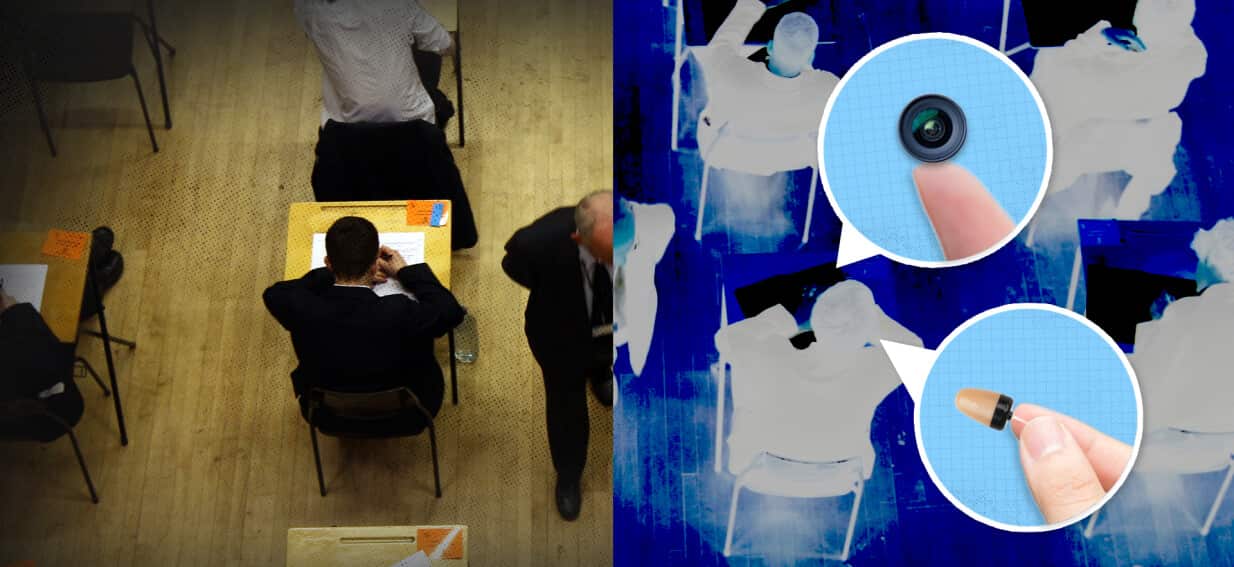
Charlotte had seen advertisements for the technology before — small cameras disguised as buttons, paired with wireless earpieces, designed to be used without attracting the attention of exam supervisors.
"Some of these cameras can vibrate. They can vibrate a certain number of times to indicate the answer choice," she says.
As technology makes it easier to capture and transmit exam material, universities face a new challenge: how to maintain exam integrity when questions can leave the room almost as quickly as students do.
Following the University of Sydney exam leak, SBS Chinese searched Douyin using keywords including "Australian exams" and identified dozens of accounts advertising button-sized devices designed to secretly photograph exam papers.
Many accounts posted so-called "first-person footage" as a promotional tactic.
We approached five random sellers on the platform as part of our investigation. All said they could provide a complete cheating setup consisting of a button camera and a wireless earpiece "the size of a grain of rice", with the equipment available to either rent or buy.
Rental prices ranged from 3,000 yuan ($626) to 5,000 yuan ($1,044), while buying the equipment cost between 8,000 yuan ($1,672) and 11,000 yuan ($2,298).
One seller said: "The camera transmits the footage, while the earpiece is used to hear the answers. Once the camera captures the exam paper, we can see it on our end and then transmit the answers to you through the earpiece."
The seller said the students could either find someone themselves to answer the questions or pay an additional fee for "teachers who have graduated in the same discipline" to provide real-time assistance during the exam.
"Go with our teachers and the exam is guaranteed. Even though the University of Sydney has tightened its rules, our clients still pass," they said.
Another seller said the service would typically involve three "teachers" helping one student — two answering questions in real time and a third reading the answers to the student through the earpiece.
A third seller claimed to have sold more than 10 sets of the equipment in June alone.
The sellers assured the devices were "extremely discreet", with the camera designed to look like an ordinary button.
They also offered to provide training before the exam to show students how to set up the equipment and test that it was working properly.
The University of Sydney says it has made progress in its investigation into the June cheating incident, but declined to say how many students it is investigating.
A university spokesperson told SBS Chinese: "In this exam period and on previous occasions, we've identified a number of 'cheating jackets' with hidden cameras used to take photographs of exam papers, to be relayed via a connected device to someone outside the venue."
"These cheating companies are predatory and brazen. We've increased our support to students so they can seek help and report any approaches or suspicious behaviour."
The university said anyone found to have engaged in misconduct would face consequences under its disciplinary procedures.
Australia's higher education regulator says commercial academic cheating remains a persistent problem.
By December 2024, the federal government's Tertiary Education Quality and Standards Agency (TEQSA) had blocked 422 websites offering illegal academic cheating services, including businesses that arrange for someone else to complete assessments on behalf of students.
Meena Jha, an associate professor at CQ University's School of Engineering and Technology, who has researched academic integrity in higher education, says the technology available to students is also changing.
She says new wearable technologies can include smart glasses, micro-earpieces and screen-enabled pens.
"If they are internet-connected, they can transmit data in real time while they are sitting, writing, doing the exam," Jha tells SBS Chinese.
Jha says the University of Sydney incident reflects a wider challenge for universities as the technology becomes more accessible.
"These technologies are available and as the technological costs are going down, they will be more available to our students," she says.
"These are quite alarming things and how universities are trying to grapple or to address these issues is a challenge."
The challenge is not limited to Australia. Regulators and education providers overseas are also dealing with the use of phones and other connected devices.
In the United Kingdom, exam regulator Ofqual reported 2,225 cases of student malpractice involving mobile phones and smart devices in tertiary and senior school exams in 2025, accounting for 44.3 per cent of all cheating cases.
For some students, the problems begin after the exam.
SBS Chinese found that after the University of Sydney exam incident, some academic appeals agencies started posting on social media, offering services to students facing university investigations.
These commercial agencies claim to help students accused of academic misconduct prepare for university hearings and appeals. Their services can also extend to other university matters, including applications to withdraw from subjects after the usual deadline, grade or assessment appeals, special consideration, and enrolment or course progression disputes.
But the services can be expensive, and the outcome is not guaranteed.
Faye (not her real name), an international student at Monash University, was one of those who sought help to improve her overall grade.
In January, concerned that a subject result could affect her future studies, Faye was introduced to an agency offering what it described as an "exceptional withdrawal" service.
The agency proposed that she apply for a withdrawal by providing medical evidence that she had experienced special circumstances while studying the subject.
"They said they had partnerships with local hospitals [in China], and that I could specify which hospital I wanted. They could contact them and arrange a certificate," Faye tells SBS Chinese.
The agency told her mental health issues were among the most common grounds for such applications.
The medical certificate and its NAATI (National Accreditation Authority for Translators and Interpreters) translation cost an additional 2,750 yuan ($573), bringing the total to 7,250 yuan ($1,513).
The agency later told Faye that the university had changed its policy and would no longer accept medical certificates issued in China. Instead, she was required to obtain a certificate from a GP in Australia.
She then paid $45 out of pocket to obtain a medical certificate from a Melbourne GP and, with the agency's help, submitted the documents to the university. However, her application was rejected.
Hongzhi Zhang, a senior lecturer at Monash University's Faculty of Education, who studied cultural perspectives in education, believes a lack of information is a primary reason students turn to commercial appeals agencies.
Universities generally provide students access to support and advice through their own services, but some students may not know those options are available.
Zhang says some students may not trust the support their universities provide and may believe external organisations can better represent their interests.
He says students may also assume paying an outside organisation gives them a better chance at securing a favourable outcome.
"The internal support services are there to advocate for students and represent their interests. They can provide you with more accurate information, whereas external organisations may exaggerate the problem and make students even more anxious," he tells SBS Chinese.
Sean Li is the founder of an education appeals agency based in Hangzhou, China. He graduated from RMIT University before completing a master's degree at Monash University.
He says his company was established about two years ago and currently assists between 30 and 50 students each month. His company charges around $2,000 for services related to academic misconduct cases.
Li says they first help students determine whether their actions breached university rules before helping them prepare their appeal submissions.
But he acknowledges practices within the industry, including aggressive marketing, exaggerated claims about success rates, and in some cases, the use of fraudulent documents.
"Salespeople on the front end may sometimes over-promote the service when they're marketing it, and they may make excessive promises to clients about a particular outcome."
Li says he has also seen students obtain what were described as supporting documents from other agencies, some of which he believed were not genuine.
"If those documents are checked and found to be fake, the student could be in serious trouble. They could potentially be permanently expelled."
He rejects the suggestion that appeals agencies exploit the anxiety of international students.
He says the role of an appeals agency can be compared with the support universities themselves provide to students facing disciplinary processes.
"The purpose of education shouldn't be for one failure to bring everything to an end. It should be about giving people who are willing to work hard a chance to keep moving forward."
A TEQSA spokesperson told SBS Chinese: "TEQSA is aware that commercial academic cheating services continually evolve their strategies and services."
TEQSA published resources for students in November 2025 to help them prepare for and respond to academic misconduct processes.
"These resources support students to respond to allegations of academic misconduct without purchasing support from academic cheating services," the spokesperson said.
TEQSA said anyone who comes across advertisements for commercial academic cheating services or offers to provide access to assessment materials can report them to the agency.
Zhang says universities also have a responsibility to make their processes easier for international students to understand, those from different cultural and linguistic backgrounds.
He suggests universities provide more multilingual services in addition to English, and include information about student support services when notifying students that they need to attend a hearing.
"If universities already have such comprehensive systems in place to support students, then why aren't students turning to you for help? Why are they going to external providers instead?"
Jha says universities also need to rethink how they design exams and assessments.
"If student assessment is no longer focused on rote memorisation, but instead on how knowledge is constructed, then these technologies can genuinely help students rather than being used for academic misconduct," she says.
She also recommends measures to detect Bluetooth signals and wearable devices during exams.
"There are some advanced smart gates available that can actually detect these devices when students are entering."
But she says there is a gap between rapidly evolving technology and the policies designed to regulate it.
This story was produced in collaboration with SBS Chinese. Additional reporting by Fujia Yang.