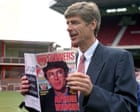
David Dein’s decision to hire the Frenchman ushered in an irreversible era of multiculturalism, giving birth to the Premier League we know today.
A s feedback goes, even a character as optimistic as David Dein might have considered the reaction to his managerial appointment suboptimal. Thirty years ago, Arsenal were in a state of flux, having sacked Bruce Rioch, with the interims Stewart Houston and Pat Rice in charge.
“His name is Arsène Wenger,” Dein, the club’s vice-chair, beamed. Famously read The London Evening Standard’s billboards before Wenger being confirmed as manager on 30 September 1996.
Wenger described the Arsenal dressing room he inherited as “culturally English” and set about making his first signings, the characteristically unknown Frenchmen in Patrick Vieira and Rémi Garde; when he left the job in 2018, every Premier League dressing room was a United Nations.
The first non-British or non-Irish manager in the top flight had been Dr Jozef Venglos, appointed by Aston Villa in 1990, ticking all the boxes of English football’s old prejudices: foreign, academic, whimsical, tactical.
“Arsène Wenger’s been in Japan, he doesn’t know anything about the English game,” said Sir Alex Ferguson, laying the foundations for a decade-long feud that would become, in Ferguson’s words, “toxic”.
Wenger’s aesthetic playing style was encapsulated upon securing his first Premier League title in 1998, with a pastiche of Total Football that culminated in Steve Bould drifting out of the back four to chip a pass on to the advancing Tony Adams, who finished in a 4-0 win over Everton.