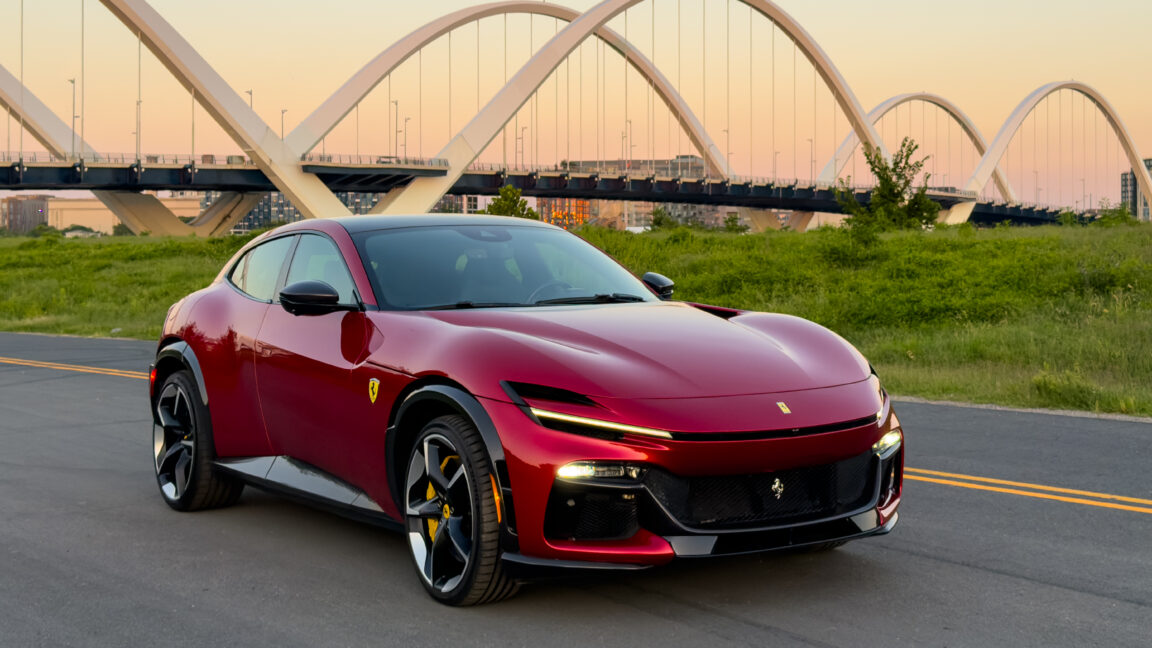
Ferrari’s two-seat sports cars might be the brand’s identity, but the Italian automaker has always catered to customers who want to bring more than one passenger along for the ride.
For one thing, there is an extra pair of doors, rear-hinged ones that provide direct access to the pair of rear bucket seats.
Underneath that long hood lives a 6.5 L naturally aspirated V12, but mounted back in the chassis such that this is technically a front-mid engined layout.
You’ll probably want to be in Sport to experience that; it’s the most extreme of the Purosangue’s settings, for you won’t find a Race mode on the steering wheel-mounted manettino dial that toggles through drive modes, although you will find one for Ice instead.
A second dial is found between the rear seats with the same functionality.
5 sentences from our version of the report,
chosen to cover it. Nothing here is written; every line is in the article below.
How
Summarized version
With the Purosangue, the rear passengers have been given something of an upgrade. Because there are four seats, you can share the experience with three passengers: The squeals of delight from happy young neighbors getting their first ride in a Ferrari were a real high point of our time with the car.
Headline check
The one thing this headline claims is in the report.
Figures, names and quoted words in the headline, looked for in the report itself — not in the summary above. One claim in this headline could be checked, so this is a narrow pass and not a thorough one. How this is checked
The article, shortened and in plain language
Ferrari’s two-seat sports cars might be the brand’s identity, but the Italian automaker has always catered to customers who want to bring more than one passenger along for the ride. Its first hatchback was still a three-door, though, and more practical for carrying cargo rather than humans in the rear. But with the Purosangue, the rear passengers have been given something of an upgrade.
For one thing, there is an extra pair of doors, rear-hinged ones that provide direct access to the pair of rear bucket seats. It’s also probably accurate that Ferrari says the Purosangue is not an SUV but an FUV—a Ferrari Utility Vehicle.
Underneath that long hood lives a 6.5 L naturally aspirated V12, but mounted back in the chassis such that this is technically a front-mid engined layout.
Which is something, considering the fact that the engine doesn’t redline until 8,250 rpm. You’ll probably want to be in Sport to experience that; it’s the most extreme of the Purosangue’s settings, for you won’t find a Race mode on the steering wheel-mounted manettino dial that toggles through drive modes, although you will find one for Ice instead.
The steering is heavier than something like a 296 but still feels direct, with good feedback of the road conditions as the front wheels are experiencing them. In Sport, you can feel the chassis control systems and the electronic differentials doing their thing to tighten your line if you’re steering and adding power at the same time.
A second dial is found between the rear seats with the same functionality.
Shortened to 1 minute
of reading, this version reads 12.6 on the Niral Score.
You are reading our version, not theirs.
This is Ars Technica's report shortened to its most important sentences, in plainer words, with
verdicts and loaded words taken out. Plain description stays, and so do adjectives
that carry a fact, such as "former" or "federal". The reporting, the facts and the quotations
are theirs — quotations are never edited — and the indicators beside it measure
this version. Hover or tap Adjectives to see every one left in the text.
How this outlet filed it, and how we rewrote it
No other newsroom we read has filed on this event, so there is nothing to compare it with yet.
Readers can ask a question about this story here.
Questions and answers are for subscribers.
Sign in
to read them.
Comments are read before they appear where anything in them needs a person to look.
Nothing posted here is ever deleted; a comment taken down keeps its text and the reason,
so the decision can be looked at again. How this works