Subscribe Sign in

World / China

Foie gras, live dolphins and toasters: China and US cut reciprocal tariffs on $30bn each of goods

The Guardian Australia (Business)
2 min read Rewritten in plain language

TariffsTrump TariffsUS NewsChinaUS Foreign Policy

Changed after publishing · 1 edit
  • the headline was changed: Foie gras, live dolphins and toasters: China and US cut reciprocal tariffs on $30bn each of goods

Outlets edit stories after they go out, usually without saying so. We keep what we saw the first time.

Show what we removed
  • The US and China have released reciprocal lists of goods worth about $30bn each on which they plan to cut tariffs, ranging from consumer electronics and agricultural products to artificial flowers and live dolphins.
  • The reciprocal Chinese list features 1,619 types of US product including a broad range of food such as butter, offal, lobster and foie gras.
  • Zhu Tian, a vice-president and co-dean at the China Europe International Business School (CEIBS) in Shanghai, said: “It is a positive step, but not a major breakthrough.”
  • The US trade representative Jamieson Greer said each side had recommended $30bn of non-sensitive trade that “could benefit from more favourable tariff treatment in the future”.
  • US whole soya beans imports – which became a Chinese target during 2025’s trade war – are not on Beijing’s tally, Reuters news agency noted, meaning they still face an additional tariff of 10%.

5 sentences from our version of the report, chosen to cover it. Nothing here is written; every line is in the article below. How

Headline check

The one thing this headline claims is in the report.

Figures, names and quoted words in the headline, looked for in the report itself — not in the summary above. One claim in this headline could be checked, so this is a narrow pass and not a thorough one. How this is checked

Read the full reportHide the full report2 min

World’s biggest economies release lists of products in latest move away from trade war – but no strategic goods are included

The US and China have released reciprocal lists of goods worth about $30bn each on which they plan to cut tariffs, ranging from consumer electronics and agricultural products to artificial flowers and live dolphins.

The announcements are the latest tack away from the intense trade war between the world’s two largest economies that dominated much of last year, though strategic products are not included and no timeline has yet been given for the reductions.

The US list includes 77 categories of Chinese products including bed linen, garden umbrellas, toasters, fish hooks and billiard balls. The reciprocal Chinese list features 1,619 types of US product including a broad range of food such as butter, offal, lobster and foie gras.

It also includes coal, scientific devices such as MRI systems, rabbit hair and several types of animals for breeding.

Han Lin, the China country director at the Asia Group, a strategic advisory firm, said: “The animal list is certainly eye-catching: donkeys, mules, horses, whales, dolphins and dugongs. But I’d read it less as an exotic trade story than as evidence of how granular tariff codes can be.”

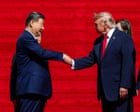
The news comes days after Xi Jinping and Donald Trump met in Washington for an optics-driven summit aimed at stabilising the two sides’ volatile relationship.

Zhu Tian, a vice-president and co-dean at the China Europe International Business School (CEIBS) in Shanghai, said: “It is a positive step, but not a major breakthrough.” He noted that the reductions covered a relatively small share of US-China trade, and that other tariffs on more strategic goods remained in place.

“Still, it is significant that the two sides are moving from simply avoiding further escalation to actually reducing some tariffs,” he added.

The agreement has been brokered through the US-China Board of Trade, set up during Trump’s visit to Beijing in May.

The US trade representative Jamieson Greer said each side had recommended $30bn of non-sensitive trade that “could benefit from more favourable tariff treatment in the future”. The list represented “improved market access for about 30% of US exports to China”, he added.

The Chinese commerce ministry said levies on more than 90% of the products would be subject to “most favoured nation” levels, according to state media.

Sensitive product categories such as semiconductors, batteries and electric vehicles are not covered in the $30bn tariff cut lists.

US whole soya beans imports – which became a Chinese target during 2025’s trade war – are not on Beijing’s tally, Reuters news agency noted, meaning they still face an additional tariff of 10%.

Meanwhile, the Xi-Trump meeting last week yielded only a two-month extension to a wider trade truce first established by the two leaders in Busan, South Korea, last year.

Han said: “Both sides are carving out non-sensitive trade where cooperation is still possible. It’s managed stabilisation, not a trade reset.”

You are reading our version, not theirs. This is The Guardian Australia (Business)'s report with its verdicts and loaded words taken out. Plain description stays, and so do adjectives that carry a fact, such as "former" or "federal". The reporting, the facts and the quotations are theirs — quotations are never edited — and the indicators beside it measure this version. Hover or tap Adjectives to see every one left in the text.

How this outlet filed it, and how we rewrote it

No other newsroom we read has filed on this event, so there is nothing to compare it with yet.

Outlet Niral ScoreAdjectivesSourcingSentimentHappiness
The Guardian Australia (Business)as they published this story 9.1 14 61 -0.1 47.6
Mundane Readneutralized from The Guardian Australia (Business) 8.5 13 61 -0.1 47.6

Sign in to react.

Comments

Nothing here yet.

Sign in to comment.

Questions

Readers can ask a question about this story here. Questions and answers are for subscribers. Sign in to read them.

Comments are read before they appear where anything in them needs a person to look. Nothing posted here is ever deleted; a comment taken down keeps its text and the reason, so the decision can be looked at again. How this works