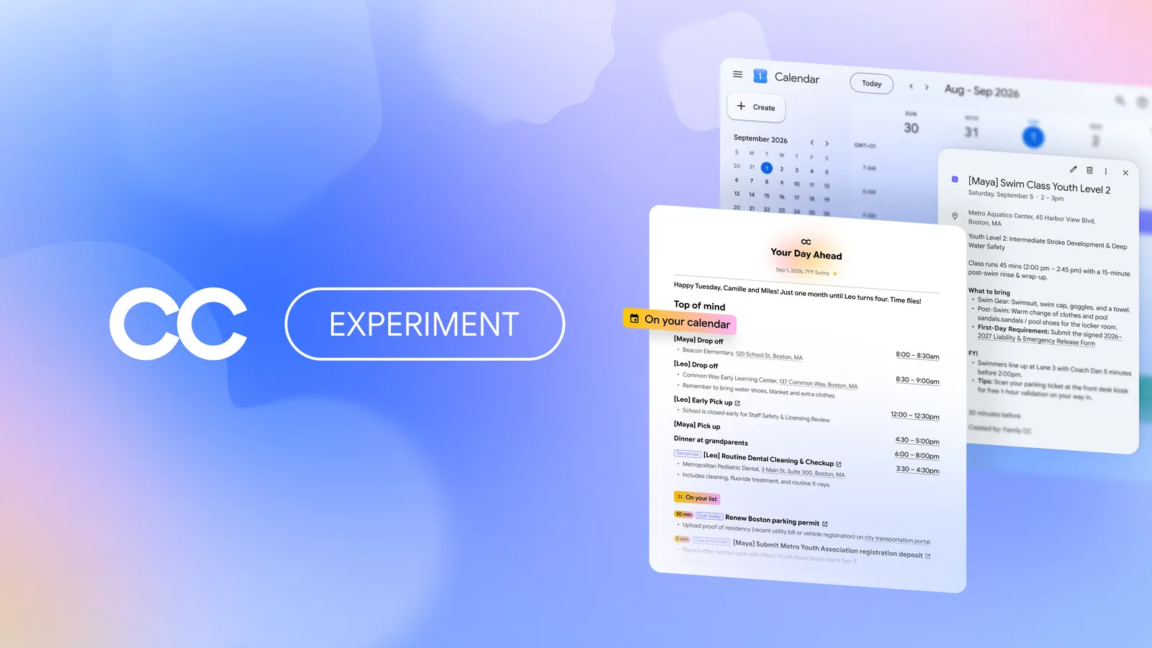
Google’s AI models may not be in the lead by most measures right now, but the company does have one advantage: your data.
CC is an evolution of something that Google announced in 2025.
Google says that CC has its own Google account, allowing each family member to interact with it as they choose.
You can do that by designating certain addresses as always available to the agent—something like school scheduling emails.
The agent can even monitor a shared Google Drive folder, into which you can dump invitations, documents, and other content.
5 sentences from our version of the report,
chosen to cover it. Nothing here is written; every line is in the article below.
How
Headline check
The one thing this headline claims is in the report.
Figures, names and quoted words in the headline, looked for in the report itself — not in the summary above. One claim in this headline could be checked, so this is a narrow pass and not a thorough one. How this is checked
The article, shortened and in plain language
Google’s AI models may not be in the lead by most measures right now, but the company does have one advantage: your data. If you’re deep in the Google ecosystem, Gemini models have a lot of context on you already. Google’s latest Google Labs experiment, known as CC, aims to expand that kind of customization to the whole family.
CC is an evolution of something that Google announced in 2025. The original CC eventually became Gemini’s Daily Brief, which churns through the data in your Google account to offer daily action items and suggestions. The new CC has a similar goal, but it’s designed to be a shared resource for up to six users in a family.
Google says that CC has its own Google account, allowing each family member to interact with it as they choose. For example, CC only sees emails from its connected users if they are explicitly shared. You can do that by designating certain addresses as always available to the agent—something like school scheduling emails.
You can also send content to CC via email or Google Chat. The agent can even monitor a shared Google Drive folder, into which you can dump invitations, documents, and other content.
Each morning, all the registered users will get a shared “Your Day Ahead” email that pulls together the day’s events and updates on previous tasks.
Shortened to 1 minute
of reading, this version reads 6.9 on the Niral Score.
You are reading our version, not theirs.
This is Ars Technica's report shortened to its most important sentences, in plainer words, with
verdicts and loaded words taken out. Plain description stays, and so do adjectives
that carry a fact, such as "former" or "federal". The reporting, the facts and the quotations
are theirs — quotations are never edited — and the indicators beside it measure
this version. Hover or tap Adjectives to see every one left in the text.
How this outlet filed it, and how we rewrote it
No other newsroom we read has filed on this event, so there is nothing to compare it with yet.
Readers can ask a question about this story here.
Questions and answers are for subscribers.
Sign in
to read them.
Comments are read before they appear where anything in them needs a person to look.
Nothing posted here is ever deleted; a comment taken down keeps its text and the reason,
so the decision can be looked at again. How this works