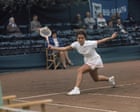
As a teenager in Sydney, the would-be Wimbledon champion was working towards a singular goal when an act of racism shattered her naivety
It was a regular match. Until it wasn’t. In 1969, I was 17 and had been living in Sydney with my tennis coach, Vic Edwards, and his family for several years. I had left my home town of Barellan – on Wirajudjuri country in the Riverina region of New South Wales – to pursue my tennis dreams in the big smoke.
The year before, I had finished high school at Willoughby girls high – where I was the only Aboriginal student – and I was doing my secretarial course in the city. The Metropolitan Business College where I studied was located near the headquarters of the Foundation for Aboriginal Affairs.
The idea for the foundation was to give city-based Aboriginal people a cultural hub where we could come together and find support. I was spending more and more time there with my friends Isabel and Bob, the latter whom I was casually dating.
Isabel and Bob were young and lots of fun but they were also acutely aware of the politics of being Black. I was naive to the injustices of Australia – and the world – and I learned a lot from Isabel and the guys at the foundation.
At the time, I was focused on a single goal: to become the first Aboriginal tennis champion. To achieve that goal, I had to shut myself off from everything other than tennis. That included politics.
I was training for my upcoming European tour, and part of program included playing doubles with Vic Edwards’ daughter, Trisha, at the White City badge competition twice a week. Trisha and I had been playing together for years and were the pair. We were the “tennis twins”, in our matching dresses, at tournaments.
It was during our usual doubles game at White City against two older women that something happened. Trisha and I convincingly won against our opponents, and we went to the net to shake their hands. As we reached over the net, though, one of the ladies turned to her partner and said, “That’s the first time I’ve ever been beaten by a n*****r.”
The N-word. I had never been called it before. I went into shock.
The word took a moment to sink in. At first, I thought I had misheard. But then Trisha responded with a cutting comment and I knew it was real. Still, the moment felt far away, as though it was happening to someone else.
The older women left and I remained at the net with Trisha. Suddenly, we were crying. We both stood in the centre of the court, hugging and sobbing. The word had wounded me like a paper cut, innocuous at first, then stinging. I’m not sure why that single word had such an effect on me. It wasn’t even an Australian slander. The N-word was a cheap, American slur that reminded me of fake soap-opera trash talk. But when it was directed at me, it felt real. Was this the way it was going to be out there in the mean streets of tennis?
Still sobbing, I called the first person I thought of: Isabel at the foundation. Through tears, I told her what happened. “You jump in a taxi and get here right now,” she said.
When I arrived, I was greeted by Isabel and Bob. They held me and patted my back as I cried in their arms. Isabel said she had never seen me so upset. We sat around and drank cups of coffee for hours, talking it over. “It’s OK,” Bob told me, kindly. “These things happen to us all the time. You just have to deal with it, and you can. You’re strong.”
Something had irrevocably changed within me. My naivety had been broken. The protective bubble my family and the Edwardses had built around me had been smashed. I would move on but to never be the same innocent young girl.
When I got back to the house hours later, Trisha had already relayed the events to Mr Edwards. I was glad to have missed his initial anger at the incident. Mr Edwards – who was quick to anger – was matter-of-fact. He had informed the NSW Lawn Tennis Association over the phone and was in the middle of writing an official complaint. “We have to deal with this in the proper manner, through the correct channels,” he said.
I don’t know what happened as a result of the call or the complaint. But I never saw the woman at White City again.
After that, I spent more and more time at the foundation. My friends there reminded me of my people but not in a way that made me homesick; instead, they gave me a sense of feeling good about being Aboriginal. Proud – that was it! They made me feel proud to be Aboriginal.
When I went on to win my first Wimbledon singles tournament two years later in 1971 – becoming the first Aboriginal woman to claim the title – the win was for all Aboriginal people.
I like to think I was doing my part in my own way – by breaking new ground, taking up space and inspiring the next generation of hopeful Aboriginal athletes.
I hope I have paved the way for our young ones, and that the road is a lot smoother these days.