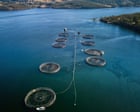
Salmon companies operating in Tasmanian marine areas deployed almost 1,800 explosives in first half of 2026, government figures reveal
More than 150,000 underwater explosives have been used to deter seals at Tasmanian salmon farms since 2016, according to new government data.
Department of Natural Resources and Environment (NRE Tas) data released last week revealed salmon companies directed almost 1,800 underwater explosives at seals at fish farms in the first half of 2026.
Since the start of 2016, the three salmon companies operating in Tasmanian marine areas – Huon Aquaculture, Tassal and Petuna – have deployed 150,488 underwater explosives.
Four fur seals died in the first half of 2026 – two at Tassal leases and two at Huon Aquaculture sites. Two died entangled at salmon cages, one from a boat strike and another in an attempt to sedate and relocate an animal. Since the start of 2021, 48 seals have died at Tasmanian salmon farms.
The use of underwater explosives against seals has declined since April 2021, possibly in response to the publication of Richard Flanagan ’s book Toxic. Since early 2022, NRE Tas has released biannual data, with a company-by-company and month-by-month breakdown of the use of devices against seals, after a right-to-information request by the Tasmanian Inquirer.
Huon Aquaculture, owned by the Brazilian meat company JBS, accounted for 1,126 of the explosives used in the first half of 2026, almost two-thirds of the total. Of these, 892 were used at the company’s leases in Storm Bay off the coast of Bruny Island, with the remainder at sites in the D’Entrecasteaux Channel and Huon River.
Huon is now the largest salmon producer in the state, according to an analysis of government production data published by SalmonBusiness. After rotting salmon flesh washed up on beaches in the D’Entrecasteaux Channel in early 2025, and incidents of mass deaths at fish farms over the past two years, the company launched a PR campaign, including a video featuring seals swimming in the ocean.
Tassal’s 2025 sustainability report said the company aimed to “phase out” the use of seal deterrents, but did not specify a deadline.
Huon was asked whether it had a policy to phase out deterrents, and whether the high level of underwater explosive use against seals at the Storm Bay leases indicated the cages there were more prone to breakage due to exposure to rougher conditions.
The company did not respond to these specific questions, but a Huon spokesperson said the company took its responsibility to protect wildlife seriously and was evaluating initiatives to improve wildlife safety. “This includes upgrades to existing infrastructure, adoption of new technologies to deter wildlife, and engagement with specialist consultants to assess and reduce interaction risks,” the spokesperson said.
In its sustainability report, Tassal reported that seals gained access to salmon cages 1,100 times in the past three years. It said there was a 26% fall in seals getting into cages in 2025 compared with the previous year.
But the company’s use of explosives against seals has begun rising again after four years of decline. In the first half of 2026, it used 551 explosive devices, more than double the number in the same period in either of the two preceding years. More than half of these devices were used at leases on the Tasman Peninsula.
Tassal also used 31 bean bag rounds – fabric-coated plastic shells containing lead shot – against seals at its leases on the Tasman Peninsula. Tassal is the only salmon company that uses these devices in Tasmania.
Tassal was asked whether its increased use of explosives at its Tasman Peninsula leases was due to the seal population near Nubeena growing, and whether the company had an end date for using devices against seals. Tassal, which is owned by Canadian multinational Cooke Aquaculture, did not respond.
Petuna, the smallest of the state’s three marine salmon producers, used 82 underwater explosives against seals at leases in Macquarie Harbour and 38 at leases in the Tamar River.
This article was republished with permission from the Tasmanian Inquirer