 Engadget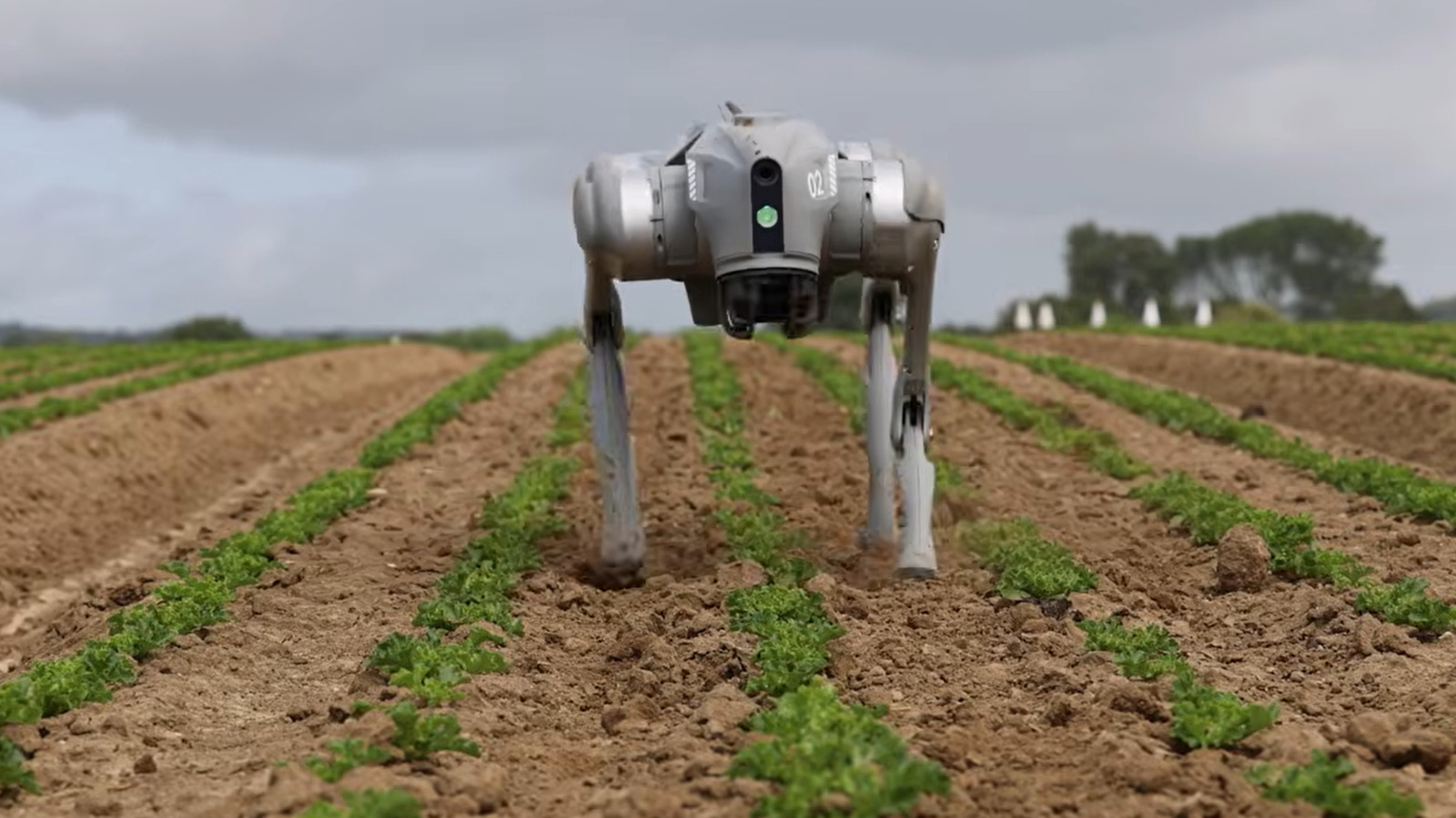
Moving beyond security details to crop surveillance.
A new technology is cropping up in fields and greenhouses across the globe: robotic dogs. The result of explosions in robotic and artificial intelligence (AI) technologies, these anthropomorphic rovers have made headlines for their use in security details, guarding everything from international borders to the President's Palm Beach resort.
In the agricultural industry, American farmers have begun to deploy the robots to guard high value crops, where thermal sensing and electro-optical cameras detect threats, record incidents for analysis and alert staff to issues in real time. And while the idea of AI watch dogs seems straight out of a market paperback dystopia, some developers believe they will be more useful outside of their security teams.
Robotic dogs equipped with AI vision models are beginning to fill a hole in farmers' datasets. Previously, farmers have had to rely on satellites, drones and manual inspections to measure crop yields, track high-level trends and detect diseases. Such methods are limited, resource intensive, and, in the case of drones, impractical for greenhouse crops. Rovers and other agronomical machinery, meanwhile, lack the dexterity to traverse uneven terrain without damaging crops.
In light of these challenges, agronomists have been searching for a means of automating analytical processes that require eyes on the ground. Four-legged robots offer a solution by capturing high resolution images of crops and sending them through AI vision models to create functional datasets for farmers to better understand their crops. Volkswagen, for instance, deployed robotic sheep to study agrivoltaics at its Polish solar farm. Developers hope that they will help solve some of the most intractable agricultural problems: fighting invasive pests, spotting weeds and phenotyping crop-killing diseases.
One of the companies pioneering this work is Swiss agriculture technology firm Synergenta. Partnering with the University of Nottingham, Synergenta created a robodog it hopes will solve some of the most difficult, time intensive, and resource intensive problems facing farmers today.
At first glance, the robodog resembles a miniature four-legged Waymo. It's equipped with multiple cameras, including spinning Light Detection and Ranging (LIDAR) scanners that use laser pulses to create 3D models of the field around it and high resolution cameras that snap images of the crops. Whether quadrupeds could be affected by a potential FCC ban of similar imaging technologies in drones is unclear, however.
The robots also house a graphical processing unit, or GPU, which allows them to locally run images through the company's advanced computer vision models. According to its creators, the robot can detect weeds, point researchers towards possible diseases and aid in the detection of pests.
Robodogs may pioneer an exciting new era of agricultural data mapping. More dexterous than rovers, advancements in robotics have enabled these quadrupeds to get up and personal with crops without damaging them. This ability to function in wet and muddy conditions proves critical to handling a field's uncertain terrain. Greenhouses may experience an acute leap in productivity, with robodogs filling a gap made by drones and other technologies that are impractical for enclosed, sensitive environments.
According to Rob Lind, a Computer Vision and AI fellow with Syngenta, the robodog's greatest strength may be their ability to harness the large stores of information created by, and affecting, farmer's crops. "Plants speak to us in the language of the light," said Lind in a company press release, "and robodogs are ideally placed to see these messages to allow us to act upon them."
Agricultural robots could prove a boon for farmers with limited bandwidth. Detecting diseases and invasive species is labor intensive. Because inspections needed to be done manually, errors and late detections are common.
One company, DEEP Robotics, announced in August 2026 that its robotic dog could reduce manual workloads of grape farmers in China's Turpan region by 70 percent. Moreover, the ability to create workable prediction models could prove invaluable for agricultural research and development, when studying new seed varieties and crop yields.
Labor concerns are sure to be paramount. Potentially capable of operating in shifts around the clock, quadrupeds could potentially reduce the need for physical workers to run inspections. A balance will need to be struck between increasing productivity and protecting the rights of laborers.
According to Lind, the robots will likely fit within a web of technological and manual processes to monitor agricultural crop health. "There's a gap, as it were, for an extra imaging platform in the field, or in the greenhouse," he said in a video announcing the company's robotic pooch. "There's already satellites, there's drones, there's phones. So, it's basically integrating the dog into this matrix of imaging platforms."
Synergenta isn't alone in developing the high tech crop-doctors. Researchers at several universities are developing their own versions, including the University of Minnesota, North Carolina A&T and Purdue, to name a few. In Italy, robot dogs have been used to clean public beaches, while in China AI-enabled quadrupeds have been deployed to detect invasive fire ant populations.
These developments may prove the beginnings of a new era in agricultural industrialization. As Lind noted in a video by Synergenta, "Think of the early days of drones and look where they are now. Give it five to 10 years, and it'll probably be unrecognizable."