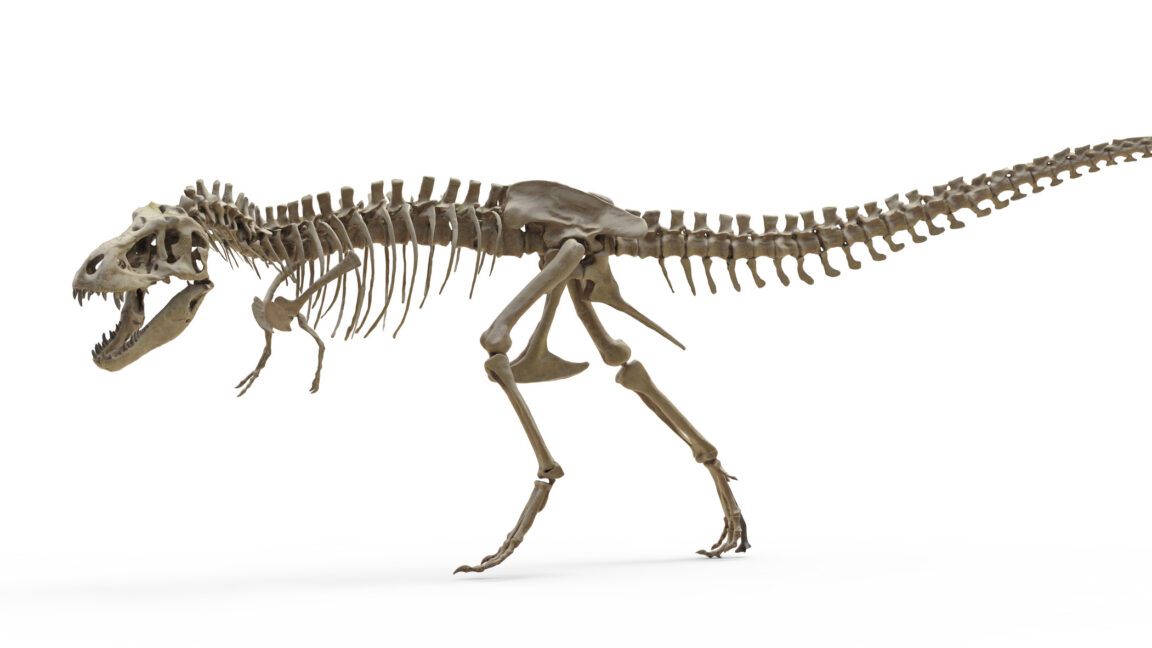
For most of the last century, T. rex was pictured as a sluggish, tail-dragging reptile that had to warm up in the sun before it could go anywhere. Then, further research changed that view, replacing it with the active, bird-like animal shown in the movie Jurassic Park.
A team of researchers led by Randon J. Flores and Robert A. Eagle, geochemists at the University of California, Los Angeles, has measured the T. rex body temperature by analyzing its teeth.
Earlier attempts to measure T. rex ’s temperature relied on oxygen isotopes in bones and teeth.
Flores, Eagle, and their colleagues got around that with a technique called clumped isotope thermometry, which Eagle introduced to dinosaur research over a decade ago in work on Jurassic sauropods. Carbonate minerals in tooth enamel contain heavy isotopes of carbon and oxygen.
The team analyzed three T. rex teeth provided by the Natural History Museum of Los Angeles County, all from Montana’s Hell Creek Formation, which preserves the final period of time before the asteroid impact. Two of the teeth belonged to a young adult T. rex that likely weighed over 3 tons.
First, though, the team had to make sure that 66 million years underground hadn’t changed the chemistry of the teeth.
The two teeth from the juvenile T. rex yielded temperatures of 37.3° and 35.9° Celsius, while the tooth from the second individual came in at 34.7°. Averaged together, T. rex had a body temperature of 36.3°, give or take 2.5°.