New dock and app launcher arrive while rising memory prices revive scrutiny of a two-year-old firmware restriction
Raspberry Pi OS has gained a new desktop layout, while memory prices have revived a dispute over firmware that restricts RAM upgrades.
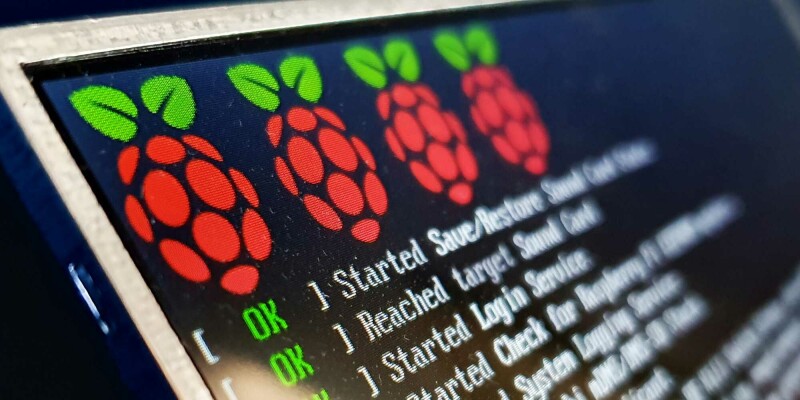
Although Raspberry Pi doesn't emphasize version numbers in its materials, the updated operating system's splash screen identifies it as version 6.3, dated September 2026. Its long-running release notes document details the changes.
This time around, the desktop GUI gets a visible revamp. In place of the vintage-Windows-style taskbar, users can now choose a dock centered at the bottom of the screen and a full-screen app launcher. There are three options: just a dock, just a taskbar, or both at once – in which case the panel goes transparent and disappears from view except for the status indicators at the right end.
We tried all three configurations, but missed the option to position the dock vertically. We strongly prefer that arrangement. If you too wish to conserve your vertical pixels, then use the raspi-config command to switch to X11 instead of Wayland. You lose the Raspberry Pi Connect feature, but in return you get a vertical LXDE taskbar.
It looks good. We suspect the design is intended to be less intimidating to children more familiar with smartphones than desktop Windows – still an audience for the Pi.
Under the hood, the Pi OS Wayland desktop components have been updated – the release notes say "labwc and wlroots updated to version 0.20." That is behind version 0.20.2 of the labwc compositor, and The Reg FOSS desk still feels some concern when confronted with pre-1.0 version numbers. We thought Wayland was meant to be mature and ready for enterprise production by now.
The underlying Linux kernel remains at version 6.18, which arrived in the previous update we reported on back in June.
Pi OS remains lightweight and fast, although it is not as svelte as it once was. While looking at the SpacemiT K3 in June, we noted that a 8 GB Raspberry Pi 5 cost a £168 in the UK or $175 in the US. Things have not improved. As we write, the 16 GB model costs £292.80 in the UK or $305 in the US.
Earlier this month, this prompted Mike Thompson, the original creator of Raspbian, to tweet: "When I created Raspbian for the Raspberry Pi, I was excited to help bring low-cost compute into the hands of a next generation of tinkerers and programmers.
"However, I now despair that a Raspberry Pi can cost upwards of $300 because AI shortages are making personal computing unaffordable. Furthermore, bright young people are being discouraged from learning programming because they are being told it is now a commodity skill that AI will do.
"I have to ask myself what it was all for. Is this the future we were promised? If so, I'm starting to regret my part in it."
He has a point. Prices like these provide a strong incentive to repair a dead Pi or upgrade a low-spec model using RAM harvested from another device. You need to be both skilled and determined to even try – it means desoldering the Pi's ball-grid-array system-on-a-chip and the RAM underneath, and then resoldering it. This is not trivial stuff.
As Pi OS 6.3 appeared, attention returned to a forum comment posted in June by Raspberry Pi Senior Principal Software Engineer Phil Elwell. He confirmed that newer firmware locks devices to their original RAM capacity.
"We therefore remove the commercial incentive by locking devices to their original RAM size," he wrote. "And for improved compatibility with a variety of suppliers, we now also program in some other device attributes, meaning that switching parts of the same size may not work. I don't see RAM being swapped between authorised devices of different sizes as a likely use case, but don't waste your time trying – it won't work."
Several stories have covered the issue this week, but our favorite comes from hardware-hacking website Hackaday, whose Arya Voronova points out that anyone capable of replacing the RAM should also be capable of downgrading to an older bootloader that does not enforce the check. Some unscrupulous resellers appear to be buying low-memory Pi boards, upgrading them, and selling them as higher-capacity models. Voronova found 15 GitHub reports from people affected – she highlights one case where a board with 8 GB of working, usable RAM describes itself as a 2 GB board, and another case where the vendor denied it.
The check was added two years ago. Voronova observes that the release notes for that bootloader omit the change. You might think a new check capable of preventing modified hardware from booting was worth mentioning.
We can't fault her summary: "Don't lament Raspberry Pi RAM upgrades, especially given they're only slightly harder to perform now. Very few hackers ever performed them, the main audience for them turned out to be dodgy hardware resellers online, and in most cases, repair doesn't seem to be impeded at all, either." ®