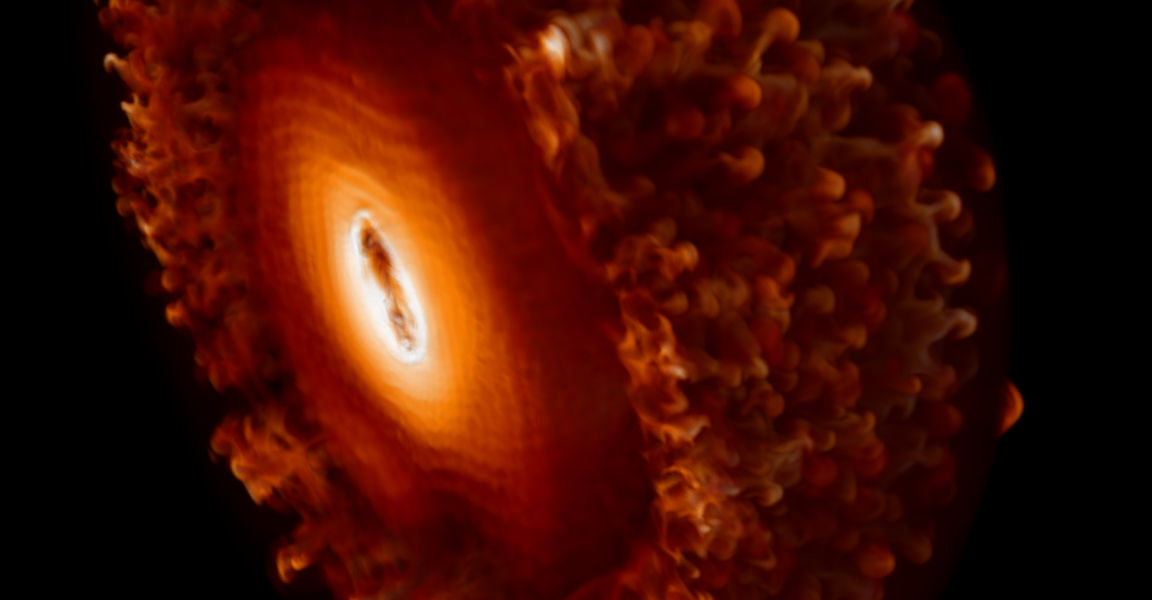
Our basic understanding of core-collapse supernovae hasn’t changed in decades.
The lack of energy from these reactions allows gravity to pull the interior of the star in on itself, collapsing it into a neutron star or black hole.
A paper being released by Physical Review D provides what might be a potential explanation for the discrepancy: flavor-changing neutrinos.
Other problems come from observations of gravitational waves generated by mergers of the black holes left behind after a supernova.
Neutrinos are produced in prodigious quantities both by the fusion reactions that take place during a supernova and by the formation of neutron star material at the heart of the collapse.
5 sentences from our version of the report,
chosen to cover it. Nothing here is written; every line is in the article below.
How
Summarized version
On the theoretical side, there are still plenty of uncertainties, including over some of the basics, such as whether all core collapses result in a supernova. Neutrinos are produced in prodigious quantities both by the fusion reactions that take place during a supernova and by the formation of neutron star material at the heart of the collapse.
Headline check
There is nothing in this headline a machine can check against the report: no figure, no name and no quotation.
Our basic understanding of core-collapse supernovae hasn’t changed in decades. Large stars burn through all the fuel at their cores and start creating heavier elements in reactions that consume energy. The lack of energy from these reactions allows gravity to pull the interior of the star in on itself, collapsing it into a neutron star or black hole.
The energy released by this process then blows the remainder of the star apart.
A paper being released by Physical Review D provides what might be a potential explanation for the discrepancy: flavor-changing neutrinos.
We’ve observed plenty of supernovae, so it would seem like there would be little mystery left.
Other problems come from observations of gravitational waves generated by mergers of the black holes left behind after a supernova.
On the theory side, things have been in a bit of flux.
Neutrinos are produced in prodigious quantities both by the fusion reactions that take place during a supernova and by the formation of neutron star material at the heart of the collapse.
With fewer photons coming out of the core of the star, that material lacks the energy to resist the pull of gravity and starts rushing toward the core.
One potential problem with the models that show neutrino heating is that they treat neutrinos as a single factor. Neutrinos don’t want to be pinned down that way.
Given their model, the researchers simulate the deaths of nearly 200 progenitor stars, ranging in mass from nine times that of the Sun all the way up to 120 times.
Shortened to 1 minute
of reading, this version reads 10.1 on the Niral Score.
You are reading our version, not theirs.
This is Ars Technica's report shortened to its most important sentences, in plainer words, with
verdicts and loaded words taken out. Plain description stays, and so do adjectives
that carry a fact, such as "former" or "federal". The reporting, the facts and the quotations
are theirs — quotations are never edited — and the indicators beside it measure
this version. Hover or tap Adjectives to see every one left in the text.
How this outlet filed it, and how we rewrote it
No other newsroom we read has filed on this event, so there is nothing to compare it with yet.
Readers can ask a question about this story here.
Questions and answers are for subscribers.
Sign in
to read them.
Comments are read before they appear where anything in them needs a person to look.
Nothing posted here is ever deleted; a comment taken down keeps its text and the reason,
so the decision can be looked at again. How this works