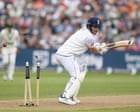
England affect’s agony on missing out at Edgbaston reminded us that however well you play, a century remains the ultimate validation
There was something about Dan Lawrence’s pained groan at Edgbaston in England’s first innings of the third Test against Pakistan. For a split second it looked as if he might plunge his bat into the turf like some tormented Norse warrior. His stumps had already been flattened by his own hand, an attempt to run the ball down past point off Mohammad Imran had ended in him hacking an innocuous delivery emphatically on to them.
The stump microphone amplified Lawrence’s anguished reaction, the noise emanating from his mouth oscillating somewhere between the visceral howl of treading on an upturned plug and the disappointed yelp of missing the last train home. He had been bowled for 65 and another chance of a first Test century had gone begging.
Test batters will tell you how they didn’t feel they “belonged” until they had made a century. That the longer they had to wait to cross the Rubicon of three figures the more it weighed them down. Lawrence has played 17 Tests for England since his first call-up in 2021. It has been a career of fits and starts, the former through no fault of his own, the past five years have seen him bat at Nos 7, 6, 5, 4 and 3 as well as a doomed stint as a makeshift opener. It’s those starts that will eat away at him though.
Lawrence is a cricketer to watch, all quicksilver wrists and homespun swagger with the bat while his jerky, “judderman” off-spin bowling and razor-sharp fielding make him an asset to any side.
In 2021, he made a plucky 73 in his first Test dig on a spinning pitch in Galle. He was left unbeaten on 81 not out at Edgbaston against New Zealand that summer. The following March he got within a few strokes of a century in Barbados but plinked a catch to cover in the last over of the day.
Lawrence knows how to score centuries. As a 17-year-old in 2015 he became the third-youngest player to make a County Championship century when he scored 161 for Essex against Surrey. Before his recall to the Test setup for the Pakistan series this summer he made five centuries in Division One of the championship including a double hundred against Hampshire.
Against Pakistan he made half-centuries in each Test, at Edgbaston he was player of the match for his runs, two wickets and a sublime diving catch. No doubt he’d give all that up and then some to have made a better decision when set on 65 and a maiden Test ton in his sights. England were in complete command – ahead by 160 runs and with Pakistan’s makeshift bowling attack there for the taking. Getting to three figures would have nailed down Lawrence’s place for the foreseeable with plenty of competition for Test batting places.
“The personal milestone achieved within a team game is one of cricket’s distinctive charms” writes Andy Zaltzman on the century. “With few if any parallels in any other sport … the transition from a two-figure to a three-figure score is cricket’s signature individual triumph. It carves an immutable notch in a player’s history and, at the highest level, an eternal legacy in the annals of the game.”
This summer’s series against Pakistan yielded precisely zero hundreds from either side, the first time a series in England (of at least three matches) hasn’t featured a century since 1888. Do we put too much emphasis on them? Perhaps. Ben Duckett is England’s only centurion this Test summer but his form has fallen off a cliff since tonning up at Trent Bridge against New Zealand. By the time Harry Brook lands in South Africa for the series beginning in December he won’t have made a Test century in 17 months … yet he has been England’s most consistent performer with the bat in that period and averages 53.
And yet the chins will start to wag about the sagging century column for Brook and the nonexistent one for Lawrence. The century is batting’s yardstick, from the amateur game to the highest level. Blame it on a decimal counting system if you want. Blame your lack of one on a lifetime of dodgy dismissals, snakepit surfaces and “unplayable” deliveries. Whatever. When it comes to centuries, you’ve either made one or you haven’t.
A man who knows that all too well is Mason Crane. After more than 10 years as a professional cricketer the Glamorgan leg-spinner has seen his batting form flourish in the past couple of years, culminating in a maiden first-class century against Surrey earlier this summer. “It’s so cool to be able to say you’ve got one” he says. “That extra column … it’s special. Everyone still puts plenty of weight on it.”
Last week Crane scored his second first-class ton, against Surrey once again. The bowler he reached the milestone off on both occasions? Dan Lawrence.
“I’ve known Dan for so long, there’s no way he would have thought he’d be bowling to me on 99 ever, never mind twice in a matter of weeks!” he said.
Perhaps it was surreal for Lawrence. Only a few days after Edgbaston, you suspect it also might have been a little bit painful.
Mason Crane’s WhatsApp profile picture is of him raising his bat after scoring his first century in June. “When I uploaded it I remember thinking, ‘I won’t be changing this for a while’ … and now I’ve got two to choose from!” Before notching that personally momentous first century earlier this summer, Crane also had the singularly painful experience of being dismissed for 99.
“Part of me thought it was a good story,” he says of falling one short, before showing that he is now in danger of developing a batter’s mindset. “After scoring two, I really wish I had a third. Greedy isn’t it? All batters are really.”
Spare a thought for Sri Lanka’s Niroshan Dickwella then. In his 56 Test matches the wicketkeeper-batter has scored 23 fifties but still not crossed the line into the sunlit and three-figured uplands. With his 2,853 century-less Test runs Dickwella is closing in on Shane Warne’s record of 3,154 – the most in Tests without converting. The 708 Test wickets would at least have taken some of the edge off for Warnie.
97.7mph (157.2 km/h) – Mark Wood’s fastest delivery in Test cricket, bowled to David Warner during the 2021 Boxing Day Ashes Test in Australia.
I’ve always tried to be resilient and come back from injury to prove people wrong and show everyone what I can do. This time I lost the battle. On medical advice, Test cricket and 50-over cricket are not possible, so the England dream has slowly been ground out of me over the past year” – Ashes, 50-over and T20 World Cup winner Mark Wood calls time on his international career due to persistent injury. He’ll go down as one of England’s fastest ever bowlers.
December 2001 | Shane Warne’s so-close-yet-so-far Test 99 reveals a typically steely bit of captaincy from England’s now-Test head honcho, Stephen Fleming. Sensing Warne’s nerves, Fleming slowed the match right down to a crawl in order to make the Aussie legend sweat. He also positioned himself at short leg for a “helpful” word or two.
“Flem comes in, says ‘there’s plenty of gaps out there for you’ and I was thinking to myself, ‘don’t do anything silly, just pick the right ball,’” Warne reflected in his autobiography No Spin. “So a couple of balls go past and I think ‘right, that’s it. This one’s going. In my head, I just thought a little sweep out to the boundary where there’s a couple of fielders. Just sweep it along the carpet and get a single … I took this almighty wind-up and tried to hit it for 12 back to Melbourne from Perth and bloody Mark Richardson had to take the catch.”
What’s worse? Replays showed the bowler, Daniel Vettori, had overstepped the front line and the delivery should have been called a no-ball. Warne never got as close again.
Phil Walker of Wisden Cricket Monthly lists 25 ways the game has changed in the 21st century.
Tanya Aldred talks to Stephen Fleming and finds England’s new Test coach planning ‘to add a bit of cricket sense in key moments’ to his players.
Warwickshire are one win away from the County Championship title. Gary Naylor sets the scene.
And, speaking of which, Somerset are poised to finish second again – and, as Andy Bull writes, after 136 years it still hurts.