Pro-datacentre officials argue scale of Australia’s buildout is smaller, more regulated and less damaging than in US.
Australian politicians and business leaders are arguing that their populace’s resentment of AI datacentres is an inauthentic import from the United States.
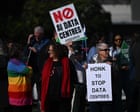
Like the US, Australia is seeing community resentment grow in response to a surge in the construction of large AI datacentres.
When the opposition began in earnest in the United States last year, it echoed slowly in Australia. In 2026, though, it has exploded into national conversation across the country, leading to calls for a national moratorium, community protests, three government inquiries, state frameworks being developed and the Australian government moving to set the rules for how the datacentres can be built, and how they consume energy and water.
In July, Victoria’s then-minister for economic growth, Steve Dimopoulos, said that his state was second only to New South Wales in terms of datacentres, and was outstripping Australia’s most populous state in growth for new centres.
“Australia’s datacentre debate is being fought on America’s facts,” Belinda Dennett, the head of the peak lobby group for the sector, Data Centres Australia, declared in a speech in March.
Dennett said the US has 5,400 datacentres, with 53.7 gigawatts of total capacity, compared with 252 in Australia with 1.4 gigawatts of capacity.
What Dennett omitted was that Australia, with a population of 28 million, has just under one datacentre per 100,000 people, compared with 1.5 per 100,000 people in the US, population 342.7 million.