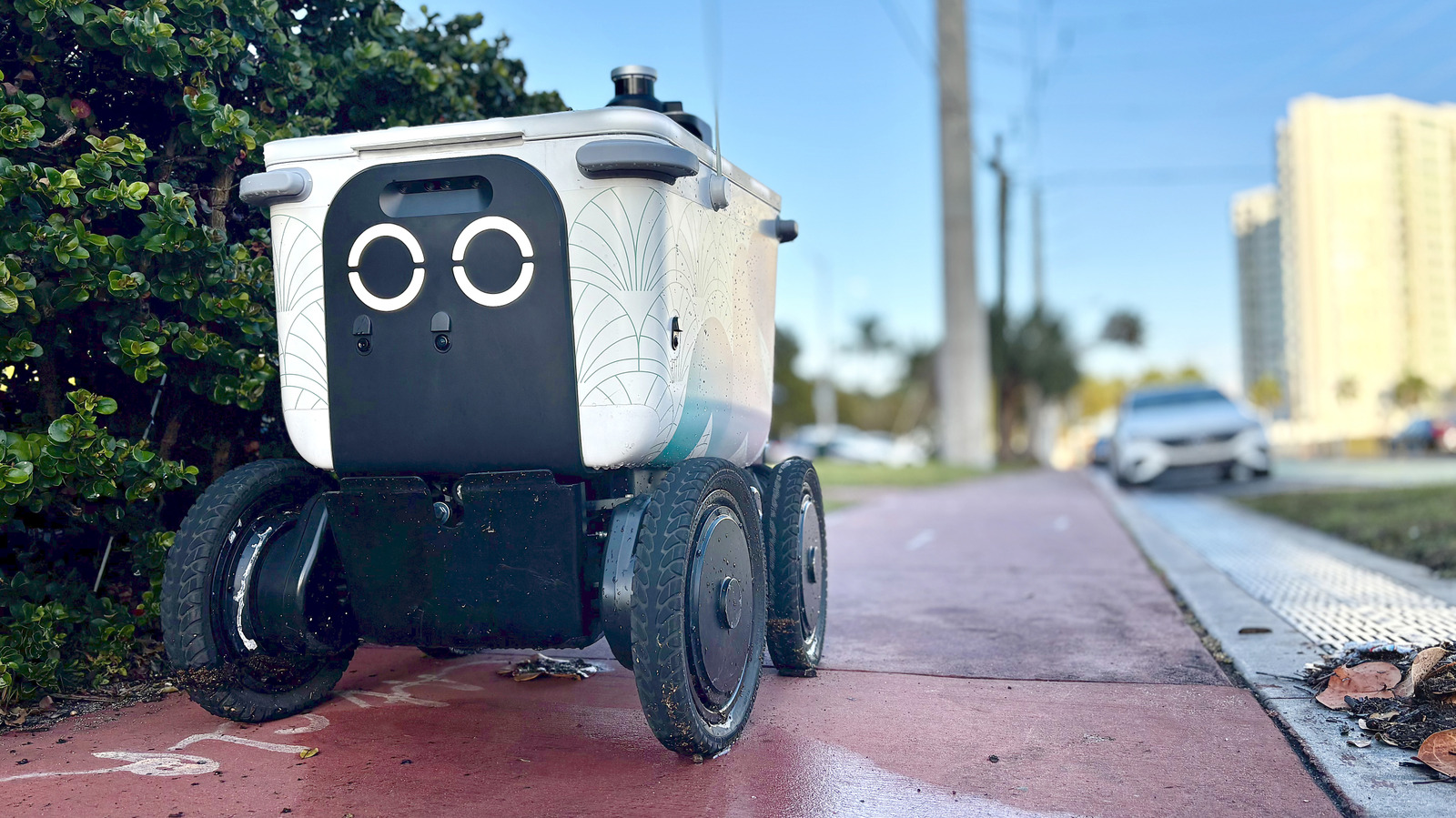
Too often, delivery robots just don't understand the rules of the road.
Some are charmed by their anthropomorphized faces and see a cute little guy doing their job, while others feel instant annoyance at what's come to be known as a "clanker" in their path.
The concept of delivery robots first began in Estonia in 2014, when Skype co-founders Ahti Heinla and Janus Friis started Starship Technologies.
Some issues are more of an annoyance, like robots interfering with restaurants with outdoor seating or other crowded businesses that spill onto the sidewalk.
A recent study by Transforma Insights suggests that the world will have 559,000 automated urban delivery vehicles by 2035, compared to 28,000 in 2025.
5 sentences from our version of the report,
chosen to cover it. Nothing here is written; every line is in the article below.
How
Headline check
There is nothing in this headline a machine can check against the report: no figure, no name and no quotation.
Too often, delivery robots just don't understand the rules of the road.
People tend to have two distinct reactions upon seeing a robot delivery driver scurrying down the sidewalk. Some are charmed by their anthropomorphized faces and see a cute little guy doing their job, while others feel instant annoyance at what's come to be known as a "clanker" in their path. Regardless of your gut reaction, they've become a large part of the delivery landscape in several countries.
The concept of delivery robots first began in Estonia in 2014, when Skype co-founders Ahti Heinla and Janus Friis started Starship Technologies. What was at first a small project saw a boom during the pandemic; the company now operates in over 80 cities across North America, Europe and Asia.
Though some robot delivery companies like Coco used to rely on remote human drivers every step of the way, almost every company in the space has shifted to autonomous robots that use a combination of camera, sensors and GPS to navigate, with human supervisors only stepping in when necessary.
Some issues are more of an annoyance, like robots interfering with restaurants with outdoor seating or other crowded businesses that spill onto the sidewalk. A man in New Jersey suffered a broken shoulder and head injury after a delivery bot hit his bike, and that's not the only instance of robot-caused harm.
A recent study by Transforma Insights suggests that the world will have 559,000 automated urban delivery vehicles by 2035, compared to 28,000 in 2025.
Shortened to 1 minute
of reading, this version reads 11.7 on the Niral Score.
You are reading our version, not theirs.
This is Engadget's report shortened to its most important sentences, in plainer words, with
verdicts and loaded words taken out. Plain description stays, and so do adjectives
that carry a fact, such as "former" or "federal". The reporting, the facts and the quotations
are theirs — quotations are never edited — and the indicators beside it measure
this version. Hover or tap Adjectives to see every one left in the text.
How this outlet filed it, and how we rewrote it
No other newsroom we read has filed on this event, so there is nothing to compare it with yet.
Readers can ask a question about this story here.
Questions and answers are for subscribers.
Sign in
to read them.
Comments are read before they appear where anything in them needs a person to look.
Nothing posted here is ever deleted; a comment taken down keeps its text and the reason,
so the decision can be looked at again. How this works
 Engadget